Lithium batteries: everything you need to know about their lifecycle and end-of-life management for professionals
Industrial decision-maker, CSR, QHSE or logistics manager, product manager, the subject of lithium batteries is at the heart of your strategies and operations.
This technology, which is omnipresent in intralogistics, tools, energy storage systems and electric vehicles, offers undeniable gains in terms of energy density, weight, lifespan, maintenance, charging speed and safety, compared to lead, NiMH or alkaline batteries.
It also asks fundamental questions:
How does a lithium ion battery work?
What is the lithium battery life cycle?
What is its ecological and economic cost?
and above all, how do you manage your end of life?
This article offers a complete and educational reading of the lithium battery life cycle., with one objective: to allow you to discover or deepen what is hidden in a battery and what are the challenges of its life cycle.
1. Understanding the lithium battery: anatomy of an energy revolution
Over the past 20 years, lithium batteries have left the status of “promising” technology to become an industrial standard. For example, they power many of our everyday objects and our vehicles, integrate photovoltaic installations using energy storage systems (ESS), and make our mobile devices more flexible to use in the field.
This very wide distribution is due to essential advantages: high energy density, satisfactory efficiency, low self-discharge, good power and a much longer lifespan than historical technologies such as lead-acid. In a context of decarbonization of uses, energy constraints and the search for operational efficiency, the movement is logical.
However, this massive adoption raises a fundamental and increasingly pressing question for any decision maker: what happens beyond the first life of the lithium battery, when it stops performing its functions properly?
To explore this question, it is imperative to know more about the entire life cycle of a lithium battery. This journey, much more complex than it seems, extends from the extraction of minerals on several continents to a final status of highly regulated waste, with risks that are not only environmental, but also regulatory, security and financial.
Composition and operating principle of the lithium battery
A lithium ion battery is not a monolithic block, but a precise assembly of electrochemical components that work in synergy. Its operation is based on the controlled movement of lithium ions within each of the cells that make up the battery.
A cell is composed of:
The cathode (+): it is the positive electrode and the component that largely defines the performance of the battery. Its chemical composition, or “chemistry”, is a strategic choice criterion:
LFP (Lithium Iron Phosphate - LiFePO4): very popular in industry for its exceptional safety (low risk of thermal runaway), its longevity (several thousand charge/discharge cycles) and its ethical profile, as it does not contain cobalt or nickel. It is ideal for heavy traction (trolleys, buses) and stationary storage;
NMC (Nickel Manganese Cobalt - LiNiMnCoO₂): this family of chemistries is renowned for its high energy density. It allows more energy to be stored in a reduced volume and weight, making it the technology of choice for light electric vehicles, where autonomy and compactness are the essential criteria.
Theanode (-): the negative electrode, almost universally composed of graphite. Its role is to receive and store lithium ions during the charging phase;
Theelectrolyte : it is a conducting liquid or gel containing lithium salts. Its role is to serve as a highway for lithium ions, allowing them to travel between the cathode and the anode. It is a flammable component, which is why safety systems are important;
the splitter : it is a thin microporous polymer membrane that physically isolates the anode and the cathode. It allows lithium ions to pass through but blocks electrons, forcing them to pass through the external circuit to create current, while preventing internal short circuits.
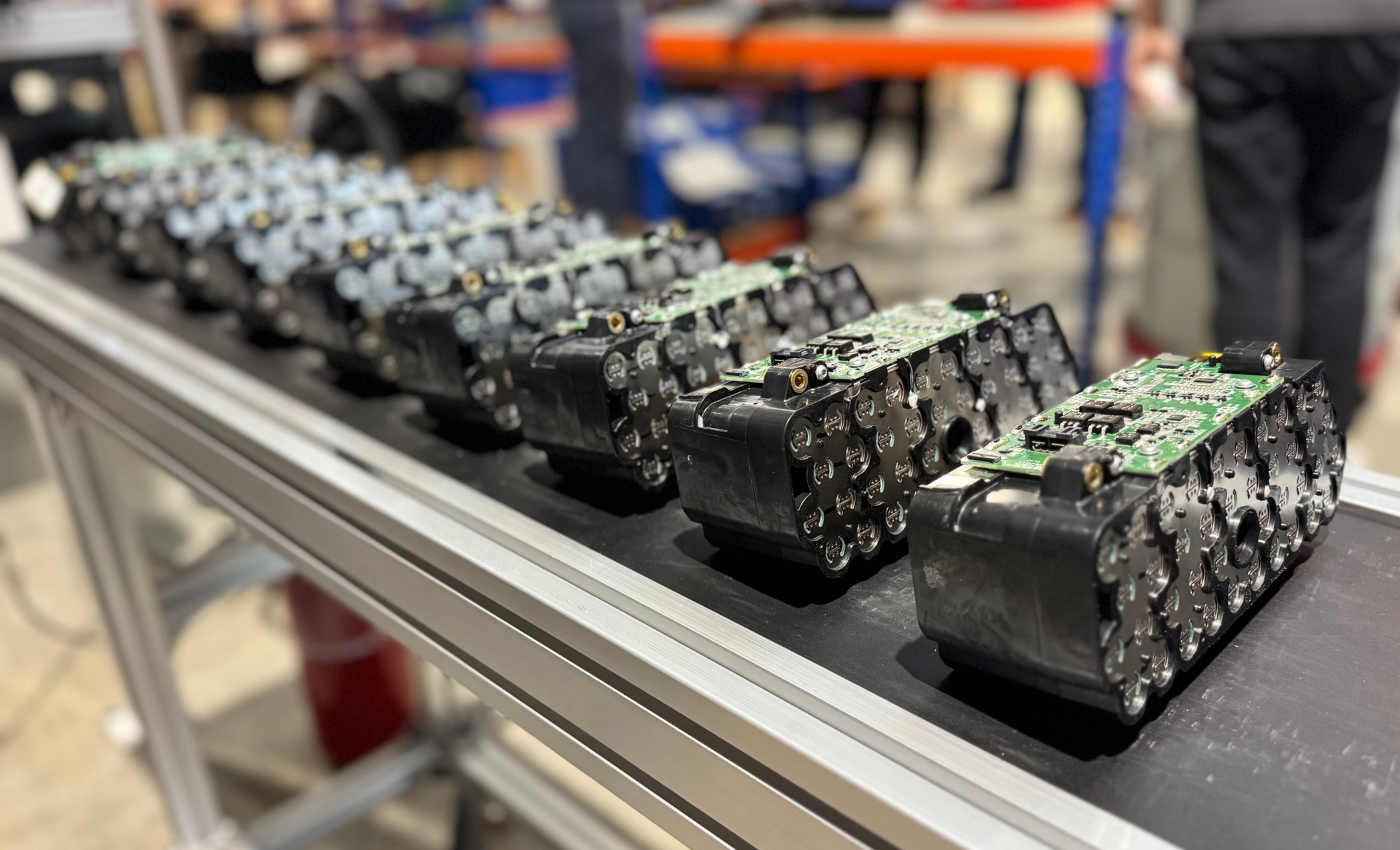
Let's add that in addition to cells connected together, a battery carries a BMS (Battery Management System). This electronic “brain” is essential. It continuously monitors the voltage, current, and temperature of each cell, balances the charge, and protects the battery against overcharging, deep discharging, and overheating, ensuring its performance and safety.
The versatility of lithium-ion technology has opened the doors to all industrial sectors:
intralogistics and handling: it's a revolution for warehouses. Forklifts, pallet trucks and AGVs (automatic guided vehicles) equipped with lithium batteries benefit from increased productivity thanks to the possibility of recharging them in short and frequent phases (biberoning), to an absence of maintenance and to better safety;
mobility and electric vehicles (EVs): the driver of large-scale adoption. From corporate fleets to city buses and last-mile delivery trucks, the lithium lithium battery offers the autonomy, the compactness, the power necessary for the needs of modern transport;
stationary energy storage (ESS): for industries, ESSs based on lithium batteries make it possible to store electricity (from the network or renewable energies) to be stored in order to restore it during consumption peaks, to ensure emergency power or to optimize self-consumption, thus reducing the energy bill;
equipment and tools: lightness, power and the absence of memory effect have made the ithium battery omnipresent in portable tools, measuring devices and other construction equipment, improving the ergonomics and efficiency of operators.
2. The lithium battery life cycle: from production to the end of the first life
The journey of a battery is a globalized and energy-consuming process. Understanding its key steps is essential to assess its true impact.
Phase 1: extraction and manufacturing of the lithium battery, a concentrated footprint
The extraction and manufacture of lithium batteries is the most intense phase in terms of environmental impacts and resource consumption.
This phase of lithium battery manufacturing breaks down into 5 steps.
Extraction of raw materials:
lithium: comes mainly either from brines from salt flats in South America (a slow and water-intensive evaporation process), or from hard rocks such as spodumene in Australia (a classic, very energy-intensive mining process);
cobalt & nickel: essential to NMC chemistries, their extraction is geographically concentrated and raises social and ethical, as well as environmental issues;
graphite & manganese: also from global supply chains.
Refining and purification: raw materials are chemically treated to reach an extreme level of purity (“battery-grade”), a stage that consumes a lot of energy and chemical reagents.
Manufacture of active components: purified powders are used to create “inks” that will be deposited on sheets of copper (for the anode) and aluminum (for the cathode).
Cell assembly: in dry and controlled rooms, the electrodes and the separator are rolled up or stacked and placed in their housing (prismatic, cylindrical or pouch) which is then filled with electrolyte and sealed. It is the basic unit of the battery.
Integration of the battery pack: the cells are assembled into modules, then into packs. The BMS, any cooling systems (liquid or air), the connectors and the external protective housing are integrated to form the final product.
Phase 2: the first life of the lithium battery, an endurance race
Once put into use, the battery starts to degrade. Its lifespan is not primarily measured in years, but rather in performance and cycles.
Cyclic life: A battery is designed to withstand a certain number of complete charge/discharge cycles before its capacity falls below a set threshold. A high quality LFP or NMC industrial battery can thus reach from 3,000 to more than 8,000 cycles.
Wear and tear: degradation is inevitable and accelerated by:
extreme temperatures: excessive heat (> 35-40°C) accelerates parasitic chemical reactions that degrade components. Extreme cold (< 0°C) slows down the kinetics and can cause lithium metal deposits during charging, damaging the battery irreversibly;
extreme states of charge (SoC): maintaining a battery constantly at 100% or leaving it discharged at 0% for long periods of time chemically stresses the electrodes;
high charge/discharge currents (C-rate): charges or discharges that are too fast generate heat and can cause mechanical and chemical stress on materials.
The end-of-first life threshold: It is not defined by a failure, but by a loss of performance. A battery is generally considered “at the end of its first life” for its initial application when it can no longer store more than 70% to 80% of its nominal energy. For some critical applications, this threshold can even be set at 90%. It is no longer efficient enough, but it is far from being “dead” (and this is what serves as the foundation of VoltR's activity). Another reality to be integrated: within a pack, all cells do not age at the same rate. It is common for a subset to fail while the rest maintain satisfactory performance. This observation opens the door to relevant remanufacturing strategies, and it calls for a serious diagnosis rather than a binary decision.
No items found.
3. The double cost of lithium batteries: ecological and economical
The evaluation of a technology cannot be done without a rigorous analysis of its direct and indirect costs over its entire life cycle.
So this is the case for the lithium battery, which has a double cost: ecological, and economic.
The carbon footprint and ecological cost of lithium batteries during their first life
The environmental impact of a lithium battery is mostly concentrated in its production phase. The key indicator is CO₂ emissions per kilowatt hour of storage capacity (kg CO2e/kWh).
Reference ranges: life cycle analyses (LCA) the most recent ones place this footprint between 60 and 160 kg CO₂ e/kWh. This significant discrepancy is explained by:
chemistry: LFP batteries, free of cobalt or nickel, are in the low range (60-90 kg CO2/kWh). NMC batteries, which are more energy-dense but dependent on high-impact metals, are in the high range (100-160 kg CO2/kWh);
the energy production mix: a “gigafactory” powered in Norway by hydroelectricity will have a much lower carbon footprint than an equivalent plant in Poland or China, where coal is still an important source of electrical energy production.
Carbon debt and the comparison with lead acid: yes, the lithium battery is born with a higher “carbon debt” than the traditional lead-acid battery. However, this trade-off changes radically over the lifespan:
durability: a lithium battery will perform 5 to 10 times more cycles than a battery using another technology. It would therefore be necessary to manufacture 5 to 10 lead batteries (and their associated carbon footprint) to equal the lifespan of a single lithium battery;
energy efficiency: the efficiency of a lithium battery is greater than 95% (the energy returned compared to the charged energy), compared to around 80-85% for lead. This means less energy wasted in each cycle, and therefore savings in electricity and CO₂ over the entire lifespan. The final balance is therefore largely in favor of lithium, provided that its end of life is managed properly.
The economic cost of lithium batteries as waste, at the end of their first life
This is an aspect that is often underestimated by businesses. A battery at the end of its first life is not only an inert object, it represents an economic cost item as a potential waste and involves legal responsibility.
Non-compliance costs: the European regulations is becoming more and more strict. Failure to ensure proper collection and treatment exposes the company to severe economic sanctions.
Storage and safety costs: a used battery is dangerous waste. It must be stored under specific conditions (ICPE sites, dedicated, isolated areas, protected against shocks and fire risks), which generates logistical and real estate costs. Administratively, traceability is essential: registers, forms, technical documentation... Transport falls under the dangerous goods regime, with packaging, labelling and specific training for operators.
Risk-related costs: an incident (fire, chemical leak) can have disastrous financial consequences: damage to infrastructure and people, stoppage of production, increase in insurance premiums...
Opportunity cost: considering the battery as simple waste to be disposed of is to ignore the value it contains. This value can be captured through recovery for a second life or for recycling.
4. The lithium battery at the end of its life, a complex and regulated waste
When a battery no longer meets the performance requirements of its initial application, it sometimes becomes necessary to dispose of it. This evolution implies a change in its status.
However, changing the status of a waste battery is not a question of the discretion of the holder, but the objective application of a legal definition.
Article L.541-1-1 of the Environmental Code defines waste precisely: waste is “any substance or object, or more generally any movable property, which the holder discards or which he intends or is obliged to dispose of”.
To consider whether a battery becomes waste, several elements must therefore be examined:
the action of the owner: to effectively dispose of the property;
the intention or obligation of the holder.
The criteria for decommissioning a lithium battery
A battery or a cell may be decommissioned, and potentially become waste (under the conditions mentioned above), in the following cases:
the residual capacity falls below the critical threshold depending on the application of the battery (e.g. 80%);
the internal resistance increases too much, preventing it from providing the power required for peak current peaks;
a defect is detected on one or more cells. In a battery pack containing tens or hundreds of cells, the failure of a single cell can compromise the performance and safety of the whole.
Used lithium batteries: risks, status and company obligations
Once removed from service, the battery is legally classified as waste (waste code 20 01 33 or 20 01 35).
With regard to batteries, this classification as waste imposes strict obligations:
safety issues: the main risk is thermal runaway. A shock, an internal short circuit, or exposure to intense heat can trigger an uncontrollable chain reaction, causing a violent fire and the emission of toxic and corrosive gases;
compliance obligations: the Extended Producer Responsibility (REP) requires the marketer to manage the end of battery life. In the event that the manufacturer on the market and the holder of the battery are different, the holder is responsible for following the sorting instructions indicated to him.
Conclusion: end of life of the lithium battery or a new start?
The lithium battery life cycle is a two-faceted journey. On the one hand, an efficient technology that is a driver of competitiveness and decarbonization. On the other hand, a complex industrial object whose production footprint is real and whose end of first life represents a concentration of safety, regulatory and economic challenges.
For professionals, the approach can no longer be linear (produce, use, discard). End-of-life management is no longer a simple cost line to be minimized, but a strategic step. It makes it possible to control risks, to comply with the law and, above all, to open the door to the circular economy.
What if the end of life was really just a transition? Isn't there a residual value in the lithium battery at the end of its first life? And how to organize a secure collection of these batteries, very specific waste as we have seen?
This is what we will explore in our next article, dedicated to concrete solutions for collection and valorization. More specifically, we will go into the “how” of storing and collecting used lithium batteries: regulatory requirements, safety, documentation, transport. Until then, this article can serve as a basis for an internal diagnosis: what is the status of our use, our monitoring of health status, and our preparation for the end of the first life of the lithium batteries used?
FAQ: everything you need to know about the life cycle of lithium batteries
1. What is a lithium ion battery? It is a rechargeable battery technology based on the movement of lithium ions between two electrodes, an anode (often made of graphite) and a cathode (LFP, NMC, etc.). Its high energy density and longevity make it the leading solution for electric vehicles, tooling and industrial energy storage.
2. What is the average lifespan of a lithium battery? Its lifespan is not measured in time but in charge/discharge cycles. For industrial applications, an LFP (Lithium-Iron-Phosphate) or NMC (Nickel-Manganese-Cobalt) chemistry battery can last between 3,000 and more than 8,000 cycles, potentially more than 10 to 15 years of intensive use.
3. What are the major ecological impacts? The main impacts are located upstream, during manufacturing. They include the consumption of water and energy for metal mining (lithium, cobalt, nickel) and the high carbon footprint of cell production, especially if factories use carbon-based electricity.
4. What happens to a battery at the end of its life? When it no longer meets the performance criteria for its initial use (generally below 80% of its capacity), it can become waste. Since the battery is a dangerous object, as waste, it must be taken care of by a specialized sector to be either reused in a less demanding application (second life), or recycled to extract valuable materials (copper, aluminum, aluminum, aluminum, lithium, cobalt, nickel).
5. How does the circular economy change the situation? It is transforming the vision of used batteries: they are no longer expensive and dangerous waste, but a resource. By extending its useful life (second life) and by recovering its components (recycling), the circular economy makes it possible to reduce the pressure on mining resources, to reduce the overall carbon footprint of the sector and to create new economic models.
Are you looking for batteries made in France, at competitive prices and while limiting their environmental impact?
By clicking on “Accept all”, you agree that cookies may be stored on your device in order to improve site navigation, analyze its use and contribute to our marketing efforts. See our privacy policy for more information.


.jpg)
